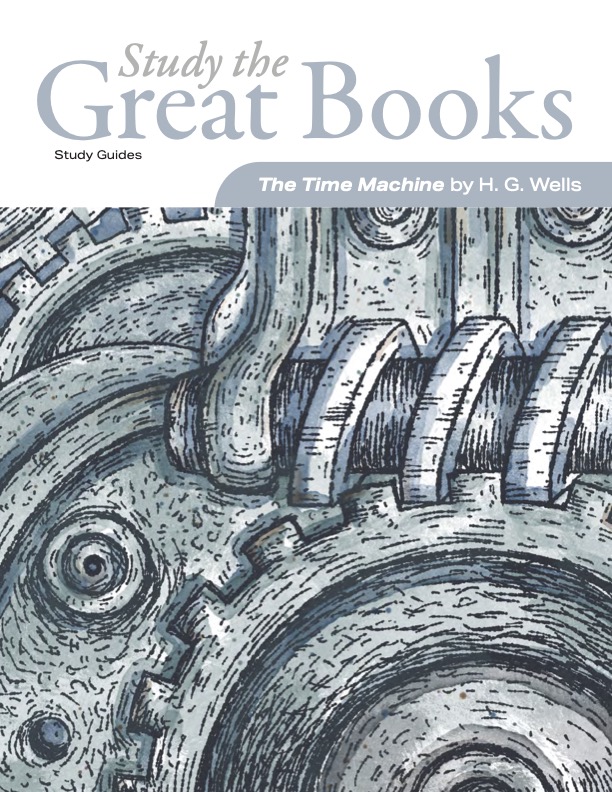
Study the Great Books: The Time Machine
Downloadable PDF
$6.99
Is time a distance which can be traversed? Is it a place to which we might travel? The Time Traveller (a title by which we alone know our main character) believes so and he is set on proving it. He has built his apparatus and done his tests, there is only left to climb into the machine himself and pull the lever. What will he find in the future? Progress! No doubt, he will find that man has climbed to the pinnacle of human potential and he will come among men in a golden age of prosperity. Reason and industry, scientific breakthroughs of all sorts, guarantee that the future of man is bright! Don’t they? Come with the Time Traveler on a journey more than 800,000 years hence into the future to find that things are altogether different from what all reason had led him to expect. Where has man gone? What has become of him? Who are these creatures he encounters now? Why do they seem terrified of the dark? Above all other questions, what have they done with his time machine and will he ever be able to get back home? Much is uncertain, but, if you have an adventurous spirit, what is certain is that you will love this harrowing tale of the future fate of man!
The Study The Great Books study guides all offer the same classically oriented and Christ exalting approach to engaging history and literature. Our guides offer students everything they need to help them read and understand primary source texts from the ancient, medieval, and modern world. Making use of the Trivium (Grammar, Logic, and Rhetoric) and sacred Scripture students engage each text through answering questions meant to ensure they understand what they have read, can interpret what they have read, can discuss the ideas they have read, and can submit all the things they are learning to God’s word as their final authority.
- Grammar Questions ask, “What does the text say?”
- Logic Questions ask, “What does the text mean?”
- Rhetoric Questions ask, “What are the main ideas in the text and what do we think about them?
- Theological Questions ask, “What does God’s word say about these same or similar things and how, therefore, ought we to think about them?”
Additionally, every STGB study guide provides students with the definitions of challenging and/or key terms found in the text, they provide descriptions of the people or characters mentioned in the text, they provide descriptions or give further information about places mentioned in the text, and they provide details about events in history which are mentioned in the text. Each of these categories is color coded to the STGB Annotation System so students can learn to mark their books well for better engagement and gain the advantage of more quickly finding the information they need upon review of a section of the book. With the use of erasable pens (recommended):
- Black is the color for underlining points of interest and making notations in the margins.
- Red is the color for underlining vocabulary words, key terms, and literary references.
- Blue is the color for underlining people or characters.
- Purple is the color for underlining places and information about geography or distances.
- Green is the color for underlining historical events and dates of importance or noting the passage of time.
Finally, every STGB study guide gives hints to Great Ideas, Virtues, and Vices which can be found in each writing. Students are encouraged to find examples of these in each reading and note them in the margins of their books so that they might learn to see common themes in history and great literature, gather excellent examples of virtue to emulate, and make note of vices to avoid. These examples often provide students with memorable quotes and examples worthy of remembering and therefore become just the kind of content perfect for recording in a Commonplace Journal. These journals become excellent resources for inspiration for writing projects and provide useful material to aid students in the completion of many of their Composition and Rhetoric assignments.