
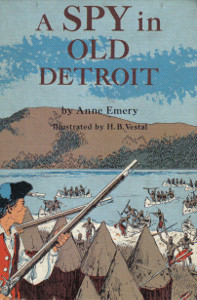
A Spy in Old Detroit
Author:
Anne Emery
Illustrator:
Herman B. Vestal
Publication:
1963 by Rand McNally
Genre:
Adventure, Fiction, Historical Fiction
Series:
"A Spy In" Series  Members Only
Pages:
216
Current state:
Basic information has been added for this book.
It has been read but content considerations may not be complete.
Book Guide




Search for this book used on:
The siege of Pontiac is an exciting period in the history of the New World, with its three-sided conflict—the French and the English in Fort Detroit, eventually uniting against the Indians, though for some time the English could not be sure where the French stood.
With complete faithfulness to historic detail—the result of extraordinarily careful research—Anne Emery has used this episode as the background for her novel. She has added to the historical conflict another conflict, equally thrilling to young people—the conflict in hero's family.
Paul Girard is torn by conflicting emotions. He is French and shares the resentment of the French toward the English who have taken over the fort. He is also sympathetic to the Indians—one of his closest friends is an Indian boy. But he has made friends among the English boys also. He worships his older brother, Philippe, who is a voyageur, and a staunch friend of the Indians. His father's insistence on remaining neutral does not make it easier for Paul.
Finally, events help Paul to make a decision and he becomes a spy for the English while his beloved brother remains their enemy. His experiences provide the suspense of the novel and will not be divulged here.
This is good entertainment as well as good history. The reader gets a fine picture of life in the old forts of that day, and of the people—the Indians, the French, and the English, with their differences and similarities, to be found among all peoples living in a small world.
Author's Note
The history in this story is true. It all happened two hundred years ago, and most of the characters in my story are true also. The Girards and Louis La Butte are people of my imagination. But the Navarres, who had a wedding for their daughter, Marie-Francoise, were living on the south coast, outside the fort, in 1763, and the man she married was the English officer, George McDougall. Her father, Robert Navarre, kept a diary of the siege. Angélique Cuillerier, the daughter of old Antoine, heard about Pontiac's plot in her father's house and warned the English, because she feared for the life of her sweetheart, James Sterling, the English trader. Two years after the siege she married him. All the French in this story are historical figures except the Girards, and most of them have descendants still living in Detroit today.
Because these people were born in the New World, they considered themselves "French-Canadian." Some had come to Detroit from Montreal and Quebec, some had been born in the little settlement on the Detroit River. I have called them French, because that was their language. They also called themselves "habitants" which, in their own tongue, meant "settlers."
The English officers and traders were historical people, too, except for Jack Bradshaw and Tom Smith, soldiers in the garrison. Sir Robert Davers was a middle-aged British tourist, who has become historical because of his part in the Rutherfurd expedition. John Rutherfurd, who was in Detroit in 1763 at the age of seventeen, has left his own story of his captivity, which happened as I have told it in this story.
The habitants believed that disaster was forecast by the strange "black rain" that actually fell in October, before the Indian uprising in May of 1763.
Most of the French spoke English as well as some of the Indian tongues; hence they could converse in French with each other or in English with Englishmen. I have not tried to indicate the use of any special language at any time, since all were used so generally. Where possible I have used Pontiac's own words, which have been recorded as part of history. His speech in Chapter 5, where he is in council with Major Gladwin and Captain Campbell, and his letter in Chapter 17 are historical statements.
There was more action and excitement than has been possible to include in the story of Paul Girard's summer under siege. Pontiac did return to try again the following year. If you want to read the real history of this event, Francis Parkman has told it completely and stirringly in his History of the Conspiracy of Pontiac.
From the dust jacket
To view an example page please sign in.

Anne Emery
1907 -1987American
Anne Emery's name is already known to librarians, teachers, and enthusiastic readers as the author of a long line of highly popular stories dealing ... See more

Herman B. Vestal
1916 - 2007American
H. B. Vestal's talented brush strokes can be found in most national magazines. Two of his best-known books are The Illustrated Book of Africa and Ex... See more
Please sign in to access the type of illustrations and view more books with this type.
Content Guide

Please sign in to access all of the topics associated with this book and view other books with the same topics.
Please sign in to access the locations this book takes place in and view other books in the same location.
Please sign in to access the time periods this book takes place in and view other books in the same time period.
For information about the lead characters please sign in.
Please sign in to discover interesting content included in the illustrations of this book.
Please sign in to access information about the content of this book that you may want to consider before reading.
Find This Book
Search for this book used on: