
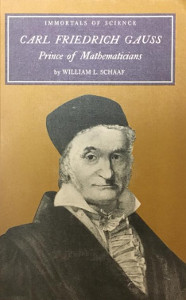
Carl Friedrich Gauss: Prince of Mathematicians
Author:
William Leonard Schaaf
Publication:
1964 by Franklin Watts, Inc
Genre:
Biography, Math, Non-fiction, Science
Series:
Immortals of Science  Members Only (World History)
Pages:
168
Current state:
This book has been evaluated and information added. It has not been read and content considerations may not be complete.
Book Guide




Search for this book used on:
CARL FRIEDRICH GAUSS' contributions to mathematics bridged the gap between the exciting discoveries of the 18th century and the sober mathematical rigor of the 19th. A master of modern analysis, Gauss was one of the last great universalists. His work reached out into many new fields. It was he who pioneered in the theory of numbers, or higher arithmetic; the theory of forms and groups, or higher algebra; theories of periodic functions, or higher trigonometry; theories of curvature, or higher geometry; the general theory of functions; including the fundamental theorem of algebra and the nature of complex numbers; and the theory of parallels, or the foundation of non-Euclidean geometry. Gauss was a man of simple wants and led an uneventful life, although he knew times of sadness and disappointment. Devoted to his family, deeply religious and somewhat fatalistic, he shunned politics, but took a lively interest in the technology of his time. His was a rare combination of tremendous creative power and relentless self-criticism. Modest but self-assured; cautious, sensitive, immensely patient, and serene—this was the Prince of Mathematicians as his contemporaries knew him.
From the book
To view an example page please sign in.

William Leonard Schaaf
1898 - 1992American
William L. Shaaf is a native New Yorker, and is a graduate of Columbia University. He began his career as an engineer, but has devoted most of his l... See more
Please sign in for additional information about this book.
Content Guide

Please sign in to access all of the topics associated with this book and view other books with the same topics.
Please sign in to access the locations this book takes place in and view other books in the same location.
Please sign in to access the time periods this book takes place in and view other books in the same time period.
For information about the lead characters please sign in.
Reviews

The Immortals of Science
Reviewed by Sara Masarik
These books are of varying lengths based on how much is known about the lives of the subject. Whatever the length, I sped through each one as though it were a suspense novel. How will this one manage to carry on his work in the midst of civil war? How can that one earn the respect of the scientific community so his work can be published for the world? What will be the exciting sequence of events that will lead to the ultimate breakthrough? Will he live long enough to find the answer he has searched for all his life?
The science in these books is written in language any curious reader will be able to understand. The authors don’t condescend, but the writing is not above a confident reader, perhaps ten and above. They would also be interesting enough for reading aloud so they can be shared with the entire family, whatever their ages.
Find This Book
Search for this book used on: