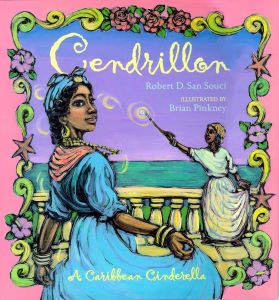
Cendrillon: A Caribbean Cinderella (Adaptation)
Content:
Cinderella
Illustrator:
Brian Pinkney
Robert D. San Souci
Publication:
1998 by Simon and Schuster Books for Young Readers
Genre:
Fairy Tales, Fiction, Folk Tales, Picture Books
Pages:
40
Current state:
This book has been evaluated and information added. It has been read but content considerations may not be complete.
Book Guide




Search for this book used on:
You may think you already know this story about a beautiful servant girl, a cruel stepmother, a magnificent ball, and a lost slipper. But you've never heard it for true.
Now you can hear the tale from someone who was there: a poor washerwoman from the island of Martinique. She has just one thing in the world to love, her goddaughter Cendrillon. When she finds Cendrillon heartsick over a rich man's son, at first she doesn't know what to do. But she has sharp wits, a strong will, and the magic wand her mother left her—and soon she has a plan to give her dear Cendrillon the gift of a love that will change her life.
A Caldecott Honor author/illustrator team brings us a unique Cinderella story, with a remarkable fairy godmother to tell the tale. Adapted from a traditional Creole story, this fresh retelling captures all the age-old romance and magic of Cinderella, melding it with the vivid beauty of the Caribbean and the musical language of the islands.
From the dust jacket
To view an example page please sign in.

Robert D. San Souci
1946-2014Robert D. San Souci has written books for both adults and children. His Enchanted Tapestry (Dial), illustrated by László Gál, w... See more

Brian Pinkney
1961-American
Brian Pinkney has illustrated many books for children, including Duke Ellington: The Piano Prince and His Orchestra and The Faithful ... See more
To view awards and booklists please sign in.
Please sign in to access the type of illustrations and view more books with this type.
Please sign in for additional information about this book.
Content Guide

Please sign in to access all of the topics associated with this book and view other books with the same topics.
Please sign in to access the locations this book takes place in and view other books in the same location.
For information about the lead characters please sign in.
Please sign in to discover interesting content included in the illustrations of this book.
Resource Guide

Podcast
Episode 70: Why Read Fairy Tales?
Released in 2020 by The Literary Life
Available formats: Streaming Audio
Length: 1 hr. 29 min.
View on the The Literary Life site
"Angelina Stanford and Cindy Rollins tackle the topic of fairy stories, discussing the what, why and how of reading them. Angelina shares the distinctive characteristics of fairy stories in contrast to other types of stories, such as myths. They deal with the question of whether fairy tales are 'escapist', the influence of the Grimm brothers scholarly work on interpreting fairy stories, and allowing the story to unveil its deeper truths without forcing meaning onto it.
Angelina gives an illustration of how to see the gospel messages in fairy tales by talking us through the story of Sleeping Beauty. She refutes the ideas that fairy tales are about human romance or are misogynistic. She also highlights some of the Enlightenment and Puritan responses to fairy tales that still linger with us today. Cindy and Angelina also discuss some common concerns such as the magical, weird, or scary aspects of fairy tales. Angelina also makes a distinction between folk tales, literary fairy tales, and cautionary tales."
Find This Book
Search for this book used on: