Conquistadors and Pueblos: The Story of the American Southwest 1540-1848
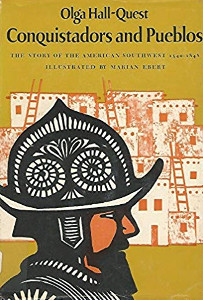
Author:
Olga Hall-Quest
Illustrator:
Marian Ebert
Publication:
1969 by E. P. Dutton & Co., Inc.
Genre:
History, Non-fiction
Pages:
256
Current state:
Basic information has been added for this book.
It is under consideration and will be updated when it is evaluated further.
Book Guide



Search for this book used on:
One of the most vivid and exciting chapters in American history is the story of the colonization and exploration of this country's great Southwest. The center of attention for this story is New Mexico and its ancient capital of Santa Fe. Around and about these points lies a fascinating story of four civilizations—Indian, Spanish, Mexican and Anglo-American.
Almost 75 years before the founding of Jamestown, Álvar Núñez Cabeza de Vaca wandered across the Southwest with three companions. The first man to see the future state of New Mexico, Cabeza de Vaca was followed by other Spanish explorers, priests and conquistadors. The Spaniards laid claim to vast areas of land and began to colonize it.
Soon, Indian populations revolted from Spanish control, drove out their foreign masters, but were reconquered. When Spain's colonial rule began to weaken, the Southwest became Mexican territory. And, finally, the Anglo-Americans brought an end to Mexican control. The United States gained possession of the Southwest and extended its boundaries all the way to the Pacific.
Men came to the Southwest for different reasons. Greed, religious faith, the search for new land to settle—these were a few. The story of early New Mexico and the surrounding territory is as rich and varied as the land itself.
From the dust jacket
To view an example page please sign in.

Content Guide

Please sign in to access all of the topics associated with this book and view other books with the same topics.
Please sign in to access the locations this book takes place in and view other books in the same location.
Please sign in to access the time periods this book takes place in and view other books in the same time period.
Find This Book
Search for this book used on: