
Elsie Piddock Skips in Her Sleep
Author:
Eleanor Farjeon
Content:
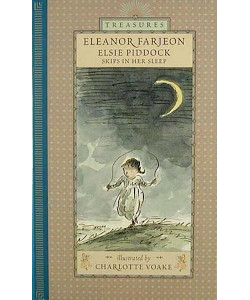
Elsie Piddock Skips in Her Sleep by Eleanor Farjeon
Illustrator:
Charlotte Voake
Publication:
1997 by Candlewick Press
Genre:
Fairy Tales, Fiction
Pages:
61
Current state:
This book has been evaluated and information added. It has not been read and content considerations may not be complete.
Book Guide



Search for this book used on:
ANdy SPANdy SUGARdy CANdy,
FRENCH ALmond ROCK!
Breadandbutterforyoursupper's-
allyourmother's-
GOT!Little Elsie Piddock is a born skipper. By the age of seven her skipping fame spreads to the fairies, and their Skipping Master, Andy-Spandy, invites her to Mount Caburn for lessons. The High Skip, the Slow Skip, the Skip Double-Double, the Long Skip, the Strong Skip, the Skip Against Trouble . . . Elsie Piddock learns them all, and before long there is not a mortal or fairy to touch her.
Then, many, many years pass—and a greedy new Lord arrives and threatens to close Mount Caburn. Can Elsie Piddock still skip as never so to save her skipping-ground for all the children and fairies?
This classic fairy story by Eleanor Farjeon, which first appeared in 1937, is published here for the first time as a picture book. With exuberant illustrations by Charlotte Voake, Elsie Piddock Skips in Her Sleep is sure to enchant a new generation of readers—and skippers.
From the dust jacket of the 2000 Candlewick Press reprint
To view an example page please sign in.


Resource Guide

Podcast
Episode 70: Why Read Fairy Tales?
Released in 2020 by The Literary Life
Available formats: Streaming Audio
Length: 1 hr. 29 min.
View on the The Literary Life site
"Angelina Stanford and Cindy Rollins tackle the topic of fairy stories, discussing the what, why and how of reading them. Angelina shares the distinctive characteristics of fairy stories in contrast to other types of stories, such as myths. They deal with the question of whether fairy tales are 'escapist', the influence of the Grimm brothers scholarly work on interpreting fairy stories, and allowing the story to unveil its deeper truths without forcing meaning onto it.
Angelina gives an illustration of how to see the gospel messages in fairy tales by talking us through the story of Sleeping Beauty. She refutes the ideas that fairy tales are about human romance or are misogynistic. She also highlights some of the Enlightenment and Puritan responses to fairy tales that still linger with us today. Cindy and Angelina also discuss some common concerns such as the magical, weird, or scary aspects of fairy tales. Angelina also makes a distinction between folk tales, literary fairy tales, and cautionary tales."

Find This Book
Search for this book used on: