Josiah W. Gibbs: American Theoretical Physicist
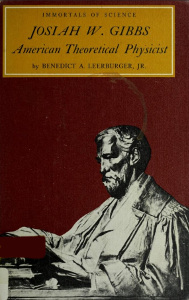
Author:
Benedict A. Leerburger, Jr.
Publication:
1963 by Franklin Watts, Inc
Genre:
Biography, Non-fiction, Science
Series:
Immortals of Science  Members Only (U.S. History)
Pages:
118
Current state:
This book has been evaluated and information added. It has not been read and content considerations may not be complete.
Book Guide





JOSIAH WILLARD GIBBS, who is regarded as one of the founders of physical chemistry, was for many years Professor of Mathematical Physics at Yale. At a time when the technology of steam engineering was half a century ahead of its theoretical understanding, Gibbs applied his brilliant mind to the complex problems of thermodynamics. His most famous contribution was the "phase rule" or law determining the number of physical phases or states possible in a specific system in equilibrium. In 1901 he received the Royal Society's coveted Copley Medal for his work in theoretical science. Gibbs was a shy and retiring man, and his work was little understood in his own time. Only today is his name receiving the just fame it so richly deserves.
From the book
To view an example page please sign in.

Benedict A. Leerburger, Jr.
1932 -American
BENEDICT A. LEERBURGER, JR., is the author of numerous science articles and is a member of the National Association of Science Writers. He has also ... See more
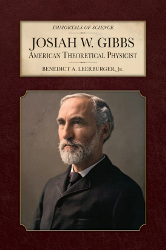

Josiah W. Gibbs: American Theoretical Physicist 
Reprinted in 2025 by Purple House Press
Available formats: Hardcover, Paperback
View on the Purple House Press site
Content Guide

Please sign in to access all of the topics associated with this book and view other books with the same topics.
Please sign in to access the locations this book takes place in and view other books in the same location.
Please sign in to access the time periods this book takes place in and view other books in the same time period.
For information about the lead characters please sign in.
Reviews
The Immortals of Science Series
Reviewed by Sara Masarik
These books are of varying lengths based on how much is known about the lives of the subject. Whatever the length, I sped through each one as though it were a suspense novel. How will this one manage to carry on his work in the midst of civil war? How can that one earn the respect of the scientific community so his work can be published for the world? What will be the exciting sequence of events that will lead to the ultimate breakthrough? Will he live long enough to find the answer he has searched for all his life?
The science in these books is written in language any curious reader will be able to understand. The authors don’t condescend, but the writing is not above a confident reader, perhaps ten and above. They would also be interesting enough for reading aloud so they can be shared with the entire family, whatever their ages.
Find This Book