
One Eye, Two Eyes, Three Eyes: A Hutzul Tale (Adaptation)
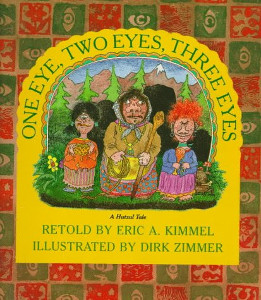
Content:
One Eye, Two Eyes, Three Eyes
Illustrator:
Dirk Zimmer
Eric A. Kimmel
Publication:
1996 by Holiday House
Genre:
Fairy Tales, Fiction, Folk Tales, Picture Books
Pages:
32
Current state:
This book has been evaluated and information added. It has been read and any content considerations have been added.
Book Guide




Search for this book used on:
Once upon a time there was a beautiful young girl named Larissa who was forced to work for Three Eyes, a hideous witch. Three Eyes had two daughters who were as ugly as she was—and just as mean. All three of them, One Eye, Two Eyes, and Three Eyes, bullied Larissa and made fun of her. Three Eyes would order her to do things that no one could possibly finish, hoping Larissa would fail. But Larissa had a secret: a magic goat who did all the terrible tasks the witch gave her, on time and perfectly.
The witch knows someone is helping Larissa, so she orders her two ugly daughters to spy on the poor girl. Larissa is surrounded by three dreadful witches and far from her loving father. Even with the little goat's help, is there any way she can live happily after?
From the dust jacket
To view an example page please sign in.

Eric A. Kimmel
1946 -American
Eric A. Kimmel is Professor of Education at Portland State University. In 1989 the Oregon Reading Association presented him with the Ulrich H. Hardt... See more

Please sign in for additional information about this book.
Content Guide

Please sign in to access all of the topics associated with this book and view other books with the same topics.
Please sign in to access the locations this book takes place in and view other books in the same location.
For information about the lead characters please sign in.
Please sign in to discover interesting content included in the illustrations of this book.
Please sign in to access information about the content of this book that you may want to consider before reading.
Resource Guide

Podcast
Episode 70: Why Read Fairy Tales?
Released in 2020 by The Literary Life
Available formats: Streaming Audio
Length: 1 hr. 29 min.
View on the The Literary Life site
"Angelina Stanford and Cindy Rollins tackle the topic of fairy stories, discussing the what, why and how of reading them. Angelina shares the distinctive characteristics of fairy stories in contrast to other types of stories, such as myths. They deal with the question of whether fairy tales are 'escapist', the influence of the Grimm brothers scholarly work on interpreting fairy stories, and allowing the story to unveil its deeper truths without forcing meaning onto it.
Angelina gives an illustration of how to see the gospel messages in fairy tales by talking us through the story of Sleeping Beauty. She refutes the ideas that fairy tales are about human romance or are misogynistic. She also highlights some of the Enlightenment and Puritan responses to fairy tales that still linger with us today. Cindy and Angelina also discuss some common concerns such as the magical, weird, or scary aspects of fairy tales. Angelina also makes a distinction between folk tales, literary fairy tales, and cautionary tales."
Find This Book
Search for this book used on: