The Goldfinch Garden
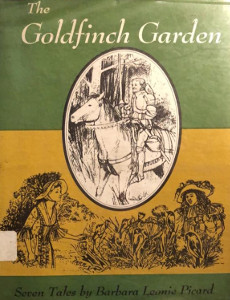
Author:
Barbara Leonie Picard
Illustrator:
Anne Linton
Publication:
1963 by George G. Harrap & Co. Ltd.
Genre:
Anthology, Fairy Tales, Fiction, Folk Tales
Current state:
Basic information has been added for this book.
It is under consideration and will be updated when it is evaluated further.
Book Guide


Search for this book used on:
In this fine collection of original fairy tales we see the author at her best. Her romantic fantasy finds a greater variety of moods than ever before—the dramatic, the gloomy, the charming, and sometimes even a wonderful sense of fun comes through in these superbly written stories.
This volume will give the storyteller and reader many, many hours in a world of enchantment. It will take its place beside The Lady of the Linden Tree and The Faun and the Woodcutter's Daughter (an ALA Notable Book for 1964 as well as a Junior Literary Guild Selection).
Because of her wit and delicate perception, based on a firm knowledge of legend and folklore, Barbara Leonie Picard is sometimes called the new Hans Christian Andersen.
From the dust jacket


Resource Guide
Podcast
Episode 70: Why Read Fairy Tales?
Released in 2020 by The Literary Life
Available formats: Streaming Audio
Length: 1 hr. 29 min.
View on the The Literary Life site
"Angelina Stanford and Cindy Rollins tackle the topic of fairy stories, discussing the what, why and how of reading them. Angelina shares the distinctive characteristics of fairy stories in contrast to other types of stories, such as myths. They deal with the question of whether fairy tales are 'escapist', the influence of the Grimm brothers scholarly work on interpreting fairy stories, and allowing the story to unveil its deeper truths without forcing meaning onto it.
Angelina gives an illustration of how to see the gospel messages in fairy tales by talking us through the story of Sleeping Beauty. She refutes the ideas that fairy tales are about human romance or are misogynistic. She also highlights some of the Enlightenment and Puritan responses to fairy tales that still linger with us today. Cindy and Angelina also discuss some common concerns such as the magical, weird, or scary aspects of fairy tales. Angelina also makes a distinction between folk tales, literary fairy tales, and cautionary tales."
Find This Book
Search for this book used on: