
The Light Princess (Adaptation)
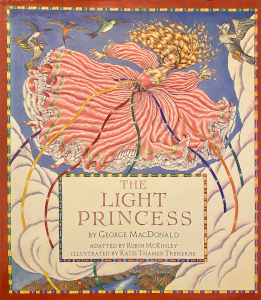
Content:
The Light Princess by George MacDonald
Illustrator:
Katie Thamer Treherne
Robin McKinley
Original author:
George MacDonald
Publication:
1988 by Harcourt Brace Jovanovich
Genre:
Fairy Tales, Fantasy, Fiction, Short Story
Pages:
43
Current state:
Basic information has been added for this book.
It is under consideration and will be updated when it is evaluated further.
Book Guide




Search for this book used on:
Once upon a time, in the days of castles and witches and magic spells, there lived a king and queen who longed for a child. When at last their wish was granted, there was joyous celebration throughout the land. The child was as lovely a princess as ever cried.
Now it does not generally matter if a king forgets to invite somebody to his infant's christening—but he must be mindful of whom he forgets. Unfortunately it was the king's own sister who was overlooked, and she was a witch. After waiting in vain for an invitation, she made up her mind to go anyway and make the whole family miserable.
In one evil moment, the atrocious witch-aunt cast a spell and deprived the child of all her gravity. It was no small matter. The little girl floated through the air like a dandelion seed. She laughed when she should have cried. Even for a princess, a life of lightweightedness and light-headedness can present royal problems.
Distinguished fantasy writer Robin McKinley has carefully preserved the fluid style and buoyant spirit of MacDonald's famous nineteenth-century story. Stunning watercolors by Katie Thamer Treherne add just the right touch of majesty—and levity— to this captivating classic.
From the dust jacket
To view an example page please sign in.


Resource Guide

Podcast
Episode 70: Why Read Fairy Tales?
Released in 2020 by The Literary Life
Available formats: Streaming Audio
Length: 1 hr. 29 min.
View on the The Literary Life site
"Angelina Stanford and Cindy Rollins tackle the topic of fairy stories, discussing the what, why and how of reading them. Angelina shares the distinctive characteristics of fairy stories in contrast to other types of stories, such as myths. They deal with the question of whether fairy tales are 'escapist', the influence of the Grimm brothers scholarly work on interpreting fairy stories, and allowing the story to unveil its deeper truths without forcing meaning onto it.
Angelina gives an illustration of how to see the gospel messages in fairy tales by talking us through the story of Sleeping Beauty. She refutes the ideas that fairy tales are about human romance or are misogynistic. She also highlights some of the Enlightenment and Puritan responses to fairy tales that still linger with us today. Cindy and Angelina also discuss some common concerns such as the magical, weird, or scary aspects of fairy tales. Angelina also makes a distinction between folk tales, literary fairy tales, and cautionary tales."
Find This Book
Search for this book used on: