
The Light Princess and Other Tales
Author:
George MacDonald
Illustrator:
Arthur Hughes
Foreword:
Roger Lancelyn Green
Publication:
1961 by Victor Gollancz Ltd
Genre:
Anthology, Classic Literature, Fairy Tales, Fantasy, Fiction, Short Story
Pages:
288
Current state:
Basic information has been added for this book.
It is under consideration and will be updated when it is evaluated further.
Book Guide




Search for this book used on:
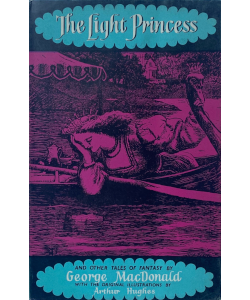
Both as a writer for adults and for children the creative stature of George MacDonald has come increasingly to be recognized, but interest in his children's books has been confined, almost entirely, to the two Curdie volumes and At the Back of the North Wind. His fairy stories, all eight of which appear in the present volume (with, for the first time in one volume, every one of the original Arthur Hughes illustrations), have not been in print since the twenties. Yet they are ageless in their appeal and are among the most enchanting works for children that George MacDonald wrote.
Each of these eight tales shows the author's skill in communicating experiences of many different kinds, supernatural and mythical ones among them; and the stories also show his wonderful insight into the minds of young people—as much today as a hundred years ago when they were written. Moreover, they are all told with a beautiful lightness of touch; the title story in particular, about a princess who has been deprived since birth of the force of gravity by a spiteful relative, is a little gem of wisdom and wit.
Roger Lancelyn Green has written the introduction.
"A number one work of real genius" — Roger Lancelyn Green
"What George MacDonald does best is fantasy. . .And this, in my opinion, he does better than any man"—C.S. Lewis
From the dust jacket
To view an example page please sign in.

George MacDonald
1824 - 1905Scottish
George Macdonald was born in 1824 at Huntly, West Aberdeenshire, Scotland, the youngest of five brothers. After studying at King's College, Aberdeen... See more
Arthur Hughes
1832-1915British
Arthur Hughes was influenced by the Pre-Raphaelite painters John Everett Millais, Holman Hunt, and Dante Gabriel Rosetti, although he never becam... See more

Resource Guide

Podcast
Episode 70: Why Read Fairy Tales?
Released in 2020 by The Literary Life
Available formats: Streaming Audio
Length: 1 hr. 29 min.
View on the The Literary Life site
"Angelina Stanford and Cindy Rollins tackle the topic of fairy stories, discussing the what, why and how of reading them. Angelina shares the distinctive characteristics of fairy stories in contrast to other types of stories, such as myths. They deal with the question of whether fairy tales are 'escapist', the influence of the Grimm brothers scholarly work on interpreting fairy stories, and allowing the story to unveil its deeper truths without forcing meaning onto it.
Angelina gives an illustration of how to see the gospel messages in fairy tales by talking us through the story of Sleeping Beauty. She refutes the ideas that fairy tales are about human romance or are misogynistic. She also highlights some of the Enlightenment and Puritan responses to fairy tales that still linger with us today. Cindy and Angelina also discuss some common concerns such as the magical, weird, or scary aspects of fairy tales. Angelina also makes a distinction between folk tales, literary fairy tales, and cautionary tales."
Find This Book
Search for this book used on: