
The Nutcracker (Adaptation)
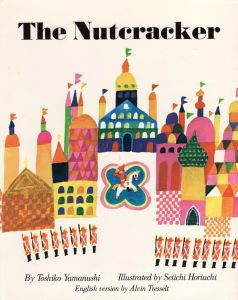
Content:
The Nutcracker and the Mouse-King by E. T. A. Hoffman
Illustrator:
Seiichi Horiuchi
Alvin Tresselt

 Complete Authored Works
Original author:
Toshiko Yamanushi
Original language:
Japanese
Publication:
1974 by Parents Magazine Press
Genre:
Fairy Tales, Fiction, Folk Tales, Picture Books
Current state:
Basic information has been added for this book.
It is under consideration and will be updated when it is evaluated further.
Book Guide


Search for this book used on:
Hidden far beneath the Christmas tree, Maria and her brother Fritz discover a surprise: a little man with a fierce scowl on his face, a dazzling gold-trimmed uniform, and a lever at his back. "His mouth must be for cracking nuts," says Fritz. "Watch! When I move this lever, it opens and closes." So the children crack nuts, and more nuts, until the poor jaw finally gives way on an extra plump pecan. Maria stays up past her bedtime to comfort her broken nutcracker, but soon, the clock strikes twelve. Then some very odd happenings take place.
In this simple and felicitous retelling of the original E.T.A. Hoffmann tale (which in turn inspired Tchaikovsky's familiar Nutcracker Suite and the ballet so popular with children round the world) even the very young will be able to follow the magical events of this eminently satisfying holiday fantasy.
From the dust jacket
To view an example page please sign in.



Resource Guide

Podcast
Episode 70: Why Read Fairy Tales?
Released in 2020 by The Literary Life
Available formats: Streaming Audio
Length: 1 hr. 29 min.
View on the The Literary Life site
"Angelina Stanford and Cindy Rollins tackle the topic of fairy stories, discussing the what, why and how of reading them. Angelina shares the distinctive characteristics of fairy stories in contrast to other types of stories, such as myths. They deal with the question of whether fairy tales are 'escapist', the influence of the Grimm brothers scholarly work on interpreting fairy stories, and allowing the story to unveil its deeper truths without forcing meaning onto it.
Angelina gives an illustration of how to see the gospel messages in fairy tales by talking us through the story of Sleeping Beauty. She refutes the ideas that fairy tales are about human romance or are misogynistic. She also highlights some of the Enlightenment and Puritan responses to fairy tales that still linger with us today. Cindy and Angelina also discuss some common concerns such as the magical, weird, or scary aspects of fairy tales. Angelina also makes a distinction between folk tales, literary fairy tales, and cautionary tales."
Find This Book
Search for this book used on: