The Warrior and the Wise Man
Author:
David Wisniewski
Illustrator:
David Wisniewski
Publication:
1989 by Lothrop, Lee & Shepherd Books
Genre:
Fairy Tales, Fiction, Picture Books
Pages:
32
Current state:
This book has been evaluated and information added. It has been read and any content considerations have been added.
Book Guide




Search for this book used on:
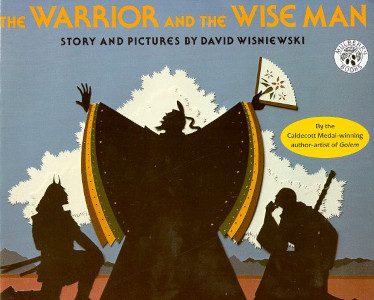
Tozaemon was the greatest warrior in the land. His twin brother, Toemon, was the greatest wise man. Their father, the emperor, set them a task: to bring him the five eternal elements. The brother who returned first with the prize would become the next emperor.
Toemon carried no swords, and his humble donkey was no match for Tozaemon's fiery steed. To gallop across the countryside, overcome the guardian demons, and ride off the precious elements would surely be easy for Tozaemon, brave and fierce and superbly trained in the arts of war. How could his thoughtful, gentle brother hope to claim the throne?
From the dust jacket
To view an example page please sign in.

David Wisniewski
(Pronounced wiz-NESS-key)1953-2002
David Wisniewski (wiz-NESS-key) was born in England. After training at Ringling Brothers and Barnum & Bailey Clown College, he spent three years... See more
Please sign in to access the type of illustrations and view more books with this type.
Content Guide

Please sign in to access all of the topics associated with this book and view other books with the same topics.
Please sign in to access the locations this book takes place in and view other books in the same location.
Please sign in to access the time periods this book takes place in and view other books in the same time period.
For information about the lead characters please sign in.
Please sign in to discover interesting content included in the illustrations of this book.
Resource Guide
Podcast
Episode 70: Why Read Fairy Tales?
Released in 2020 by The Literary Life
Available formats: Streaming Audio
Length: 1 hr. 29 min.
View on the The Literary Life site
"Angelina Stanford and Cindy Rollins tackle the topic of fairy stories, discussing the what, why and how of reading them. Angelina shares the distinctive characteristics of fairy stories in contrast to other types of stories, such as myths. They deal with the question of whether fairy tales are 'escapist', the influence of the Grimm brothers scholarly work on interpreting fairy stories, and allowing the story to unveil its deeper truths without forcing meaning onto it.
Angelina gives an illustration of how to see the gospel messages in fairy tales by talking us through the story of Sleeping Beauty. She refutes the ideas that fairy tales are about human romance or are misogynistic. She also highlights some of the Enlightenment and Puritan responses to fairy tales that still linger with us today. Cindy and Angelina also discuss some common concerns such as the magical, weird, or scary aspects of fairy tales. Angelina also makes a distinction between folk tales, literary fairy tales, and cautionary tales."

Find This Book
Search for this book used on: